Horizons Energy Group

The world's largest proven oil reserves are reopening.

303 billion barrels. A new hydrocarbons law. U.S. sanction relief. Production at a seven-year high. Venezuela's structural entry window for E&P capital is open — for those positioned to move.

Proven reserves — world's largest
303 Bnbbl

Proven reserves — world's largest

April 2026 exports, highest since 2018
1.23mbd

April 2026 exports, highest since 2018

Below historic peak: the recovery gap
~70%

Below historic peak: the recovery gap

Majors with signed 2026 expansion agreements
4+

Majors with signed 2026 expansion agreements

The Opportunity

Three converging resets create a structural entry window.

01

Legal Reset — A New Hydrocarbon Law

Gaceta Oficial Nº 6.978 (January 29, 2026) creates two investable structures — CPPs, Venezuela's PSA equivalent, and JVs with PDVSA — ending the mandatory State equity partner. Economic stabilization clauses, international arbitration under foreign governing law, direct commercialization by the private operator of its equity production, and life-of-project fiscal flexibility; no signature bonus on existing reserves. The framework is fully operational: implementing regulations since July 2026, an integrated tax of up to 15% of gross income in force since April, and standardized UNCITRAL/ICC arbitration parameters.

02

U.S. Sanction Relief — A Structured Authorization Framework

Full U.S.–Venezuela diplomatic normalization (March 2026); embassies reopened. An OFAC General License cascade (GL 46 → GL 57), with GL 52 opening full execution rights for U.S. independents. DOE, EXIM Bank, OFAC and bipartisan Congressional leadership aligned. IMF re-engagement initiated — the first since 2019.

03

Production Reset — The Recovery Curve Has Turned

1.095 mbd March 2026 production; April exports at a seven-year high. Yet output remains ~70% below the 1970s peak — a 2.5 mbd gap. Recovery is capital-intensive; entry is not. Brownfields first: low-CAPEX workovers before high-breakeven expansion.

Sources: OFAC GLs 46–57 · Gaceta Oficial Extraordinaria Nº 6.978 · U.S. Treasury · Rystad Energy · OPEC secondary sources.

The Window

The investment thesis, in four lines.

First-Mover Window

Majors and several independents have already moved. Many strong brownfield positions remain open — but they will not stay that way for long.

Asymmetric Valuation

Debt-overhang has compressed asset valuations relative to reserves. Brownfield entry pricing is extremely competitive against international alternatives; normalization drives re-rating.

Fast Oil, Lower Risk

Brownfield reactivation delivers first barrels in 6–12 months. Infrastructure exists; capital goes to workovers, logistics and reliability.

Compliance, Navigable

Activity is license-based with dedicated OFAC counsel, U.S. governing law, and offshore cash controls. Real — and engineered for.

Investment discipline

Horizons does not pursue greenfield exploration, does not transact with unsanctioned counterparties, and does not move barrels outside the scope of OFAC licenses. Everything we underwrite is brownfield, licensed and compliant.

The Infrastructure

We know the system that moves the barrels.

Venezuela's storage, terminal and refining network was engineered for 2.5–3.0 million barrels per day. Effective throughput today is capped not by geology but by deferred maintenance — tank attrition, mooring systems, dredging deficits. Knowing precisely where each constraint sits is the difference between a stranded barrel and a loaded cargo.

Marine export terminals

TerminalRole & crude slateNominal storageEffective capacityKey constraint
Jose (TAJ)Primary export gateway — 70–75% of crude flows; Orinoco blends (Merey 16, DCO)~10.5 MMbbl~50–60%SPM upkeep, transfer rates, dock congestion
Puerto MirandaLight and medium Lake Maracaibo crudes~6.0 MMbbl~40–50%Lake channel draft (~35 ft), tank attrition
Amuay–Cardón (CRP)Products, residuals and crude reception for the Paraguaná refining center~15.0+ MMbbl~55–65%Auxiliary power stability, aged manifolds
GuaraguaoClean products, light crudes and bunkers~2.5 MMbbl~45%Berth availability
La SalinaHeavy Lake crudes via offshore loading~3.0 MMbbl~35–45%Offshore manifolds, subsea line integrity

Beyond the primary gateways: inland custody-transfer depots at Punta de Mata and El Furrial buffer northern Monagas light and medium grades toward Jose; Bajo Grande dispatches asphalt and LPG for the domestic and Caribbean trade; river terminals at Boca de Uracoa and San Félix move diluted barrels down the Orinoco; and the Güiria hub in the Gulf of Paria supports deepwater ship-to-ship transfers and floating storage.

Domestic refining circuit

RefinerySystemNameplate capacityPrimary focus
AmuayParaguaná (CRP)645,000 bpdDeep conversion — FCC, flexicoker
CardónParaguaná (CRP)310,000 bpdCracking, alkylation, lubricants
Puerto La CruzOriente192,000 bpdLight and medium eastern crudes, finished fuels
El PalitoCentral140,000 bpdFCC and reforming; central-region supply
Bajo GrandeParaguaná (CRP)16,000 bpdAsphalt and basic distillation
San RoqueOriente5,000 bpdParaffins and specialty waxes
Total nominal nameplate capacity~1,308,000 bpd

In addition, the José upgraders — Petromonagas, Petrocedeño, Petropiar and Sinovensa — contribute roughly 600–700 kbd of extra-heavy conversion capacity into synthetic crude. Nameplate is not throughput, however: after years of deferred maintenance, actual refining runs at roughly 27–33% of installed capacity — and that gap is itself part of the reactivation opportunity.

Loading economics

Viscous grades and degraded pump stations stretch vessel loadings from 24–36 hours into multi-day operations. Scheduling discipline and cargo structuring directly protect netbacks — and demand the expertise and tight follow-up we provide.

Draft management

Chronic under-dredging of the Maracaibo channel caps drafts near 35 feet; full parcels are built through dual-port loadings and ship-to-ship transfers.

Deepwater dependency

VLCC economics run through single-point moorings and regional transshipment. Buoy availability and lightering logistics decide export capacity as much as wellhead volumes do.

This is the terrain our team has operated for decades — and where on-the-ground commercial presence converts constraints into margin.

Our Platform

An integrated Venezuelan energy platform: upstream execution and global commercialization.

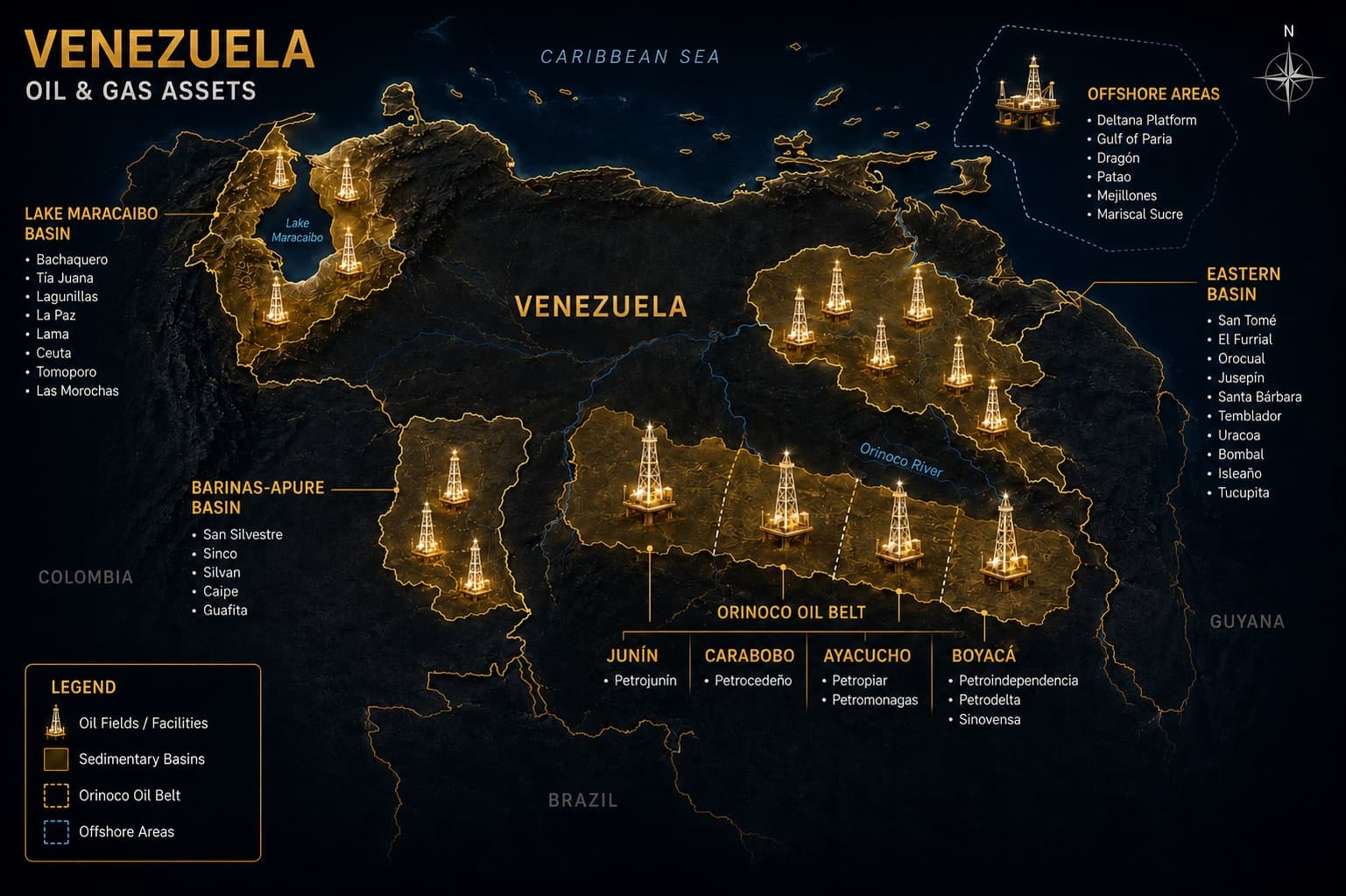
Map of Venezuela's oil and gas assets: Lake Maracaibo, Barinas-Apure and Eastern basins, the Orinoco Oil Belt and offshore areas

Multiple fields identified for negotiation · multi-billion-barrel reserves

A · Upstream — E&P

Brownfield Reactivation

  • Subsurface-to-production capability: geoscience, reservoir, drilling, workovers, production optimization, facilities and HSE.
  • Multiple fields identified for negotiation with PDVSA — multi-billion-barrel reserves across the Eastern and Western basins, all inside existing pipeline, refinery and terminal infrastructure.
  • Pre-vetted Venezuelan talent pool: 200+ years of combined local experience, ready for immediate mobilization.
  • First barrels targeted within 6–12 months of contract signature.
Aerial view of a crude oil tanker under way on deep blue water

B · Commercialization

Horizons Trading House

  • A worldwide marketing, trading and logistics unit based in Panama, trading Venezuelan crude and refined products to international markets.
  • Market access across four regions: US · Latin America · Europe · Far East, with 90+ combined years in oil & gas among senior trading partners.
  • Full-lifecycle coverage: strategic sourcing and FOB cargoes → on-site cargo execution and quality assurance → post-fixture administration, documentation control, demurrage and claims.
  • On-the-ground support in Venezuela: presence at key ports and terminals, market intelligence, stakeholder coordination and high-level negotiations.

“Production without commercialization is stranded value. Horizons integrates both.”

Team

Built by proven operators.

200+
years of combined Venezuela experience in the pre-vetted talent pool
90+
combined years among senior trading partners
4
regions of market access

William Mauco Sr.

Trading & Strategy Senior Executive · Panama

  • Former Commercial Director PDVSA (crude and product exports); VP CVP; Deltaven President; boards of Nynas, Refinery Isla and Bonaire Petroleum.
  • SVP Trading, Pacific Rubiales; co-founder and former director, New Stratus Energy.

Leonardo Belloso

President, Organización Bell · Maracaibo

  • 55+ years in hydrocarbon production in Venezuela.
  • Executive Director, Production Division, PDVSA Occidente (1.8 million bpd of potential).
  • District Manager, Lagunillas District, PDVSA Occidente (660,000 bpd of potential).

Andrés Galavís

President, INVEPET Investment Services · Panama

  • Former VP Marketing and board member, AIVEPET.
  • Former General Manager Products Trading, PDVSA (1M bpd); International Trading Manager, Maraven (800k bpd); Petroleum Engineer, Texas A&M (MS).

Emilio Vallinoti

Latin American Adviser, SOCAR Trading · Panama

  • 30+ years crude trading & business development across LATAM; 17 years at Arcadia Petroleum.
  • Built SOCAR Trading's LATAM relationships: Ecopetrol, PetroEcuador, ENAP, ANCAP, PMI/Pemex, YPF.

Backed by a pre-qualified Venezuelan technical execution team covering geoscience, reservoir, drilling, workovers, production optimization, facilities and HSE — profiles available in the data room.

How We Enter

Two contract structures. One disciplined process.

CPP

Production-Sharing Structure

  • Venezuela's PSA equivalent under the 2026 law.
  • No signature bonus; negotiable working interest, royalty and income tax.
  • 20-year initial term with renewals.
  • Direct commercialization by the private operator — no PDVSA credit risk.

Empresa Mixta

Joint Venture with PDVSA

  • Joint venture structure with PDVSA participation.
  • 40-year contract with extension.
  • Each partner funds its share.

From expression of interest to first barrels

  1. 01

    Expression of interest

  2. 02

    Field list

  3. 03

    PDVSA field match

  4. 04

    MOU + data packs

  5. 05

    Field development plan

  6. 06

    FDP & contract negotiation

  7. 07

    Signature + OFAC approval

Confidential

The full picture is in the data room.

Field-level data, indicative economics, CPP contract terms, production profiles and the complete risk framework are available to qualified investors under NDA. Access is granted by invitation after review.

Already invited? Enter the Data Room